Why Banks Freeze Checking Accounts Suddenly in 2026 (And How to Unfreeze Yours Fast)
Why banks freeze checking accounts suddenly in 2026: 7 common triggers, bank hold vs. legal levy, and a 72-hour plan to unfreeze your account fast.

Your debit card is declined, your app shows “restricted,” and nobody at the branch can say why. A sudden checking account freeze is stressful, but most freezes fall into a few clear types, and each type has its own fix. This guide shows you how to tell which one you have and what to do in the first 72 hours.
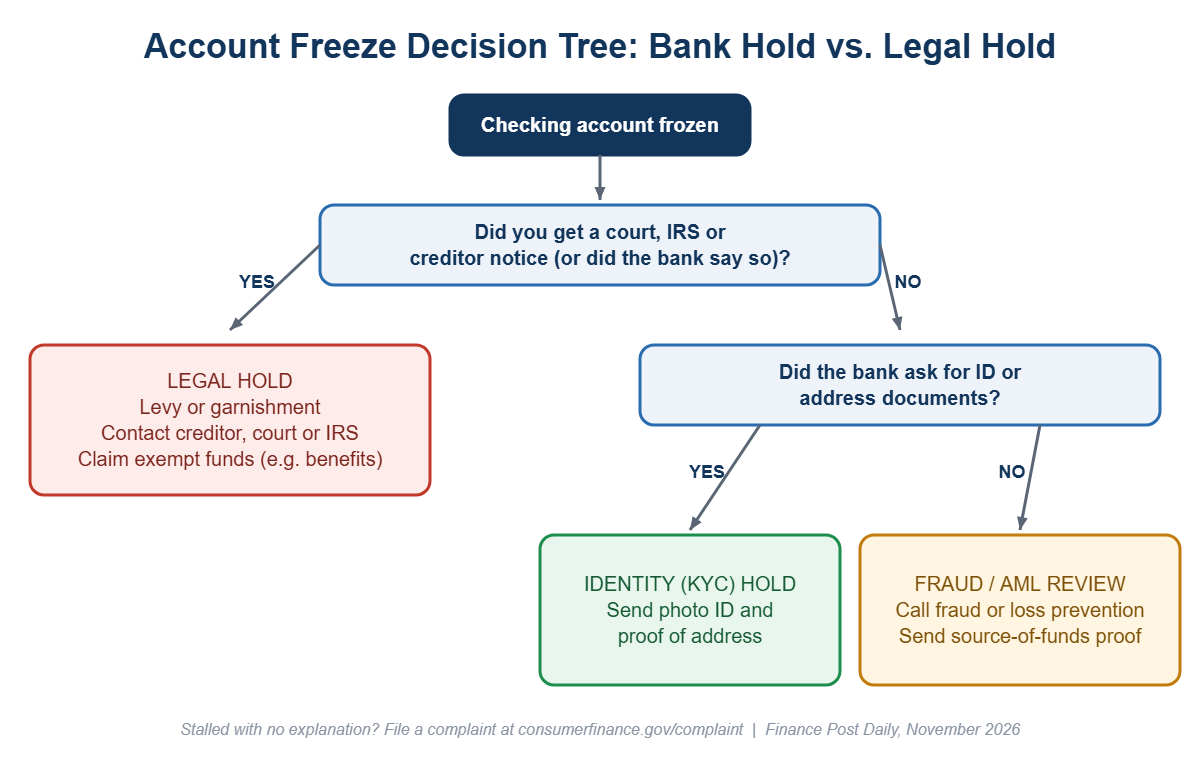
Quick Answer: Banks usually freeze checking accounts for one of three reasons: an automated fraud or anti-money-laundering alert, a court or IRS levy or garnishment, or an identity (KYC) mismatch. To fix it fast, call the bank’s fraud or loss prevention team, ask which type of hold it is, and send ID plus proof of where the money came from.
Who this guide is for: This guide covers US consumer checking accounts, which fall under federal banking rules (including the Bank Secrecy Act and Regulation CC), CFPB oversight and state court rules for levies and garnishments. UK readers: account freezes there usually come from a bank’s report to the National Crime Agency under the Proceeds of Crime Act 2002, which follows a different timeline. We cover that briefly near the end.
Table of Contents
Bank Security Hold vs. Legal Levy: Know Which One You Have
Every freeze is either the bank’s own decision or a legal order the bank must follow. This one difference decides who you need to talk to.
| Bank fraud or security hold | Legal levy or garnishment | |
|---|---|---|
| Who freezes it | Your bank, based on its own fraud, AML or identity checks | A court order from a creditor, or a levy from the IRS or a state agency |
| Does the bank warn you first? | Usually not. You may get an alert or a letter after the hold starts. | Usually not before. A notice from the bank, court or creditor often arrives after the freeze. |
| How long it lasts | No set federal limit. Often days, sometimes weeks, depending on the review. | IRS levy: bank holds funds 21 days before sending them. Court garnishment: depends on state rules. |
| How to lift it | Verify your identity and the source of funds with the bank’s fraud or loss prevention team | Pay, settle, or prove funds are exempt with the creditor, the court or the IRS. The bank can’t lift it on its own. |
7 Common Reasons Banks Freeze Checking Accounts in 2026
1. Automated fraud detection
Banks run software that scores every login and payment for risk. A pattern that looks unlike your usual activity can lock the account before a person reviews it. The CFPB has found that some banks froze accounts on false fraud flags and left customers without access for weeks.
Fraud flags often start with a real attack on your login. Our guide to online banking security tips shows 10 simple ways to protect your account so a scammer never triggers a freeze in the first place.
2. Sudden large Zelle or ACH transfers
A big transfer in or out, especially to or from someone new, can trigger a review. Money that comes in and leaves again quickly looks like a pattern scammers use, even when your reason is normal.
3. Mobile check deposit mismatches
Checks made out to someone else, third-party checks, and large tax refund checks often get flagged. Under Regulation CC, banks can put a longer “exception hold” on check deposits above $6,725 in one day, and on checks deposited to new accounts. A check hold only affects that deposit, but a suspected fake check can lead to a full account freeze.
4. Dormant account activity
An account with no activity for a long time may be marked dormant, and the bank may restrict it. Depending on your state, dormant balances are usually turned over to the state as unclaimed property after about 3 to 5 years without activity. Sudden activity on a sleeping account can also trigger a fraud check.
5. VPN or foreign login flags
Logging in from a new device, a VPN or another country can look like account takeover. The bank may lock online access until you confirm it was you.
6. Identity verification (KYC) gaps
Banks must keep verified identity details on file. A name mismatch, an expired ID, or an address the bank can’t confirm can pause your account until you send updated documents.
7. Court or IRS levies
A creditor with a court judgment, or the IRS after its final notice, can order your bank to freeze funds. The bank must follow the order. For an IRS levy, federal law makes the bank hold the money for 21 days before sending it, which gives you a window to act.
Your First 24 to 72 Hours: Step-by-Step Unfreeze Plan
Step 1 (Hour 0–24): Find out which type of freeze it is
- Check your app, email and mail. Look for a fraud alert, a document request, or a notice from a court, creditor or the IRS.
- Call the number on the back of your debit card. Ask: “Is this a bank hold or a legal order?” That one question tells you who can lift it.
- Ask to be transferred to Fraud or Loss Prevention. Frontline staff often can’t see the reason or remove the hold. The fraud or loss prevention team usually can.
Step 2 (Hour 24–48): Send the right documents
- Government-issued photo ID. A driver’s license or passport that matches the name on the account.
- Proof of address. A recent utility bill or lease if your address was flagged.
- Source-of-funds proof. A pay stub, sale receipt, IRS refund notice, or a message from the person who sent the transfer.
- Deposit receipt. A photo of the front and back of the check and the mobile deposit confirmation.
Write down the date, time, the name of each person you speak to, and any case number. Send documents through the bank’s secure message center or in a branch, not by regular email.
Step 3 (Hour 48–72): Ask the right questions
- “What exactly do you still need from me?” Get a clear list so the review doesn’t stall.
- “When will the review be finished?” Ask for a date, not just “soon.”
- “Can you release my paycheck or part of the balance?” Some banks can release some funds while the review continues.
In September 2026, FinCEN and federal banking regulators said banks may tell customers that a restriction is related to suspected fraud or suspicious activity, as long as they don’t reveal whether a Suspicious Activity Report was filed. So you can fairly ask for a general reason, even if the bank can’t share every detail.
If it’s a legal levy or garnishment
- Ask the bank for a copy of the order. It shows who the creditor is and which court issued it.
- Contact the creditor, court or IRS directly. The bank cannot remove a legal hold on its own.
- Protect your federal benefits. If Social Security, SSI, VA or certain other federal benefits were directly deposited, the bank must protect up to two months of those deposits from most garnishments. File any exemption claim by the deadline in your notice.
Escalate if the bank stalls
If the bank won’t explain the hold or keeps missing dates, file a complaint at consumerfinance.gov/complaint. The CFPB sends it to the bank, which is expected to respond within 15 days. You can also contact your bank’s federal regulator, such as the FDIC for many state-chartered banks.
Backup Plan: Keep Your Bills Paid While Frozen
- Keep a second checking account at a different bank or credit union. Even a small balance there can cover rent, utilities and groceries during a freeze.
- Move your direct deposit or split it. Many employers let you send part of your paycheck to a second account.
- Call billers before payments fail. Ask to change the payment date or pay from the backup account to avoid returned-payment fees.
- Keep an emergency cushion. A small cash fund helps with the first few days. Our guide on how to save money on a low income shows ways to build one.
Freezes and overdrafts often show up together when payments bounce. See how to avoid bank overdraft fees, and use the 50/30/20 budget rule to plan a buffer.
A Note for UK Readers
In the UK, a bank that suspects money laundering reports it to the National Crime Agency and may freeze the account. The NCA has seven working days to respond, and if it refuses consent, a further 31-day moratorium can follow. Banks are also restricted from telling you about the report, so ask your bank for its complaint process and contact the Financial Ombudsman Service if it stalls.
FAQ: Frozen Checking Accounts
How long can a bank freeze my checking account?
There is no single federal time limit for a bank’s own fraud or security hold, so it depends on how fast the review is finished. An IRS levy keeps funds held for 21 days before they are sent, and a court garnishment follows your state’s rules.
Can a bank freeze my account without telling me?
Yes. Banks often freeze first and notify you afterward, and legal levies usually arrive without warning. In 2026, regulators confirmed banks may tell you a restriction is linked to suspected fraud, so you can ask for a general reason.
What happens to direct deposits when an account is frozen?
It depends on the freeze. Some fraud holds still accept deposits but block withdrawals, while others return incoming payments to the sender. Ask the bank and, if needed, move your direct deposit to a backup account.
Can I still use my debit card or Zelle while the account is frozen?
Usually not. A freeze typically blocks debit card purchases, ATM withdrawals, Zelle and outgoing transfers. Pending checks you wrote before the freeze may also bounce.
Can a creditor take my Social Security from a frozen account?
Most creditors cannot. When a garnishment order arrives, the bank must protect up to two months of directly deposited federal benefits such as Social Security, SSI and VA benefits. Debts owed to the federal government or for child support can be exceptions.
Will a frozen account close my account or hurt my credit score?
A freeze alone doesn’t appear on your credit report. If the bank closes the account for misuse or an unpaid negative balance, it may report that to a bank screening agency, which can make opening a new account harder.
How We Checked This Guide
We checked levy and garnishment rules against federal law (IRC Section 6332 and 31 CFR Part 212) and FDIC and HelpWithMyBank guidance. Check-hold limits come from the CFPB and Federal Reserve Regulation CC thresholds that took effect July 1, 2025. Bank communication rules come from the September 2026 FinCEN and banking agencies’ joint statement. We also reviewed CFPB supervisory findings on account freezes, the CFPB complaint process, and the hold and freeze terms in Chase and Bank of America deposit agreements and Chase’s security pages. UK details come from the Proceeds of Crime Act 2002 consent regime. This guide was checked and updated on November 18, 2026.
Editorial process: Written by Afzal Butt, founder and editor of Finance Post Daily. Every rule and number in this guide was checked against the official sources listed below on November 18, 2026, and the page is updated when banking rules change.
Disclaimer: For education only, not financial or legal advice. Freeze rules vary by bank and state. If a court order or IRS levy is involved, consider talking to a legal aid office or a qualified attorney.
Final Word
A frozen checking account is fixable once you know which kind of freeze it is. Ask “bank hold or legal order?”, send ID and proof of funds to the fraud team, and escalate to the CFPB if the bank stalls. A second checking account at another bank keeps your bills paid while you sort it out.
Sources: CFPB: Regulation CC threshold adjustments, Federal Reserve: Joint Statement on SAR confidentiality (September 2026), FDIC: Garnishment of accounts containing federal benefits, HelpWithMyBank: Frozen account and garnishment, CFPB: Complaint process, Chase: How we protect you, GOV.UK: SAR moratorium period.